


I used to think renting a car in Mexico would be like anywhere else: book a cheap headline rate, swipe a card, drive away. Instead, my pickup at Cancún International Airport (CUN) turned into a master class in how Mexico car rentals really work, especially insurance, deposits, and toll roads. This is the most practical version of what I wish I’d read before I landed: exactly what happened at the counter, what I paid, what I declined, what I carried in cash, how I handled toll booths and topes, and what the return inspection actually looked like.
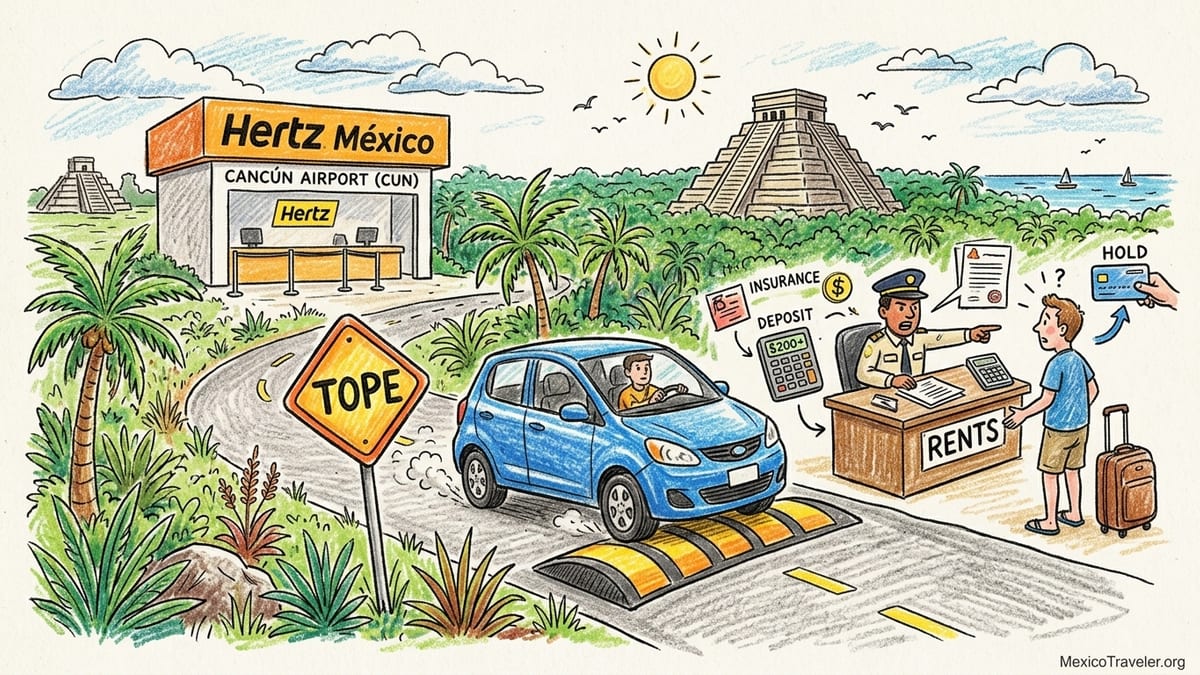
Where I Picked Up, Who I Rented From, and the Price Shock at the Counter
I picked up my rental at Cancún International Airport (CUN) from Hertz México, planning to use the car for day trips beyond the Hotel Zone. I had booked online at a headline price that looked almost too good to be true: about US$12 to US$15 per day for a basic compact. I expected taxes and maybe a modest airport fee, but not the real Mexico surprise: the conversation immediately pivoted from “your reservation” to “your protections.”
At the counter, the agent framed the deal in two numbers: (1) the cheap base rate I’d booked and (2) the total “all in” price once insurance and the security deposit were addressed. My booked price for a week came out to roughly US$95 to US$120 before arrival. The counter quote to leave with the car, keeping the base liability and declining damage coverage, landed closer to the mid US$200s once required local items, taxes, and fees were included. When they priced a package that included damage waiver style coverage, the total jumped again and could easily be double or more depending on vehicle category and how the desk bundles products.
That big swing is the pricing trap travelers keep reporting in 2025 and 2026: the headline rate is designed to get you to the counter, and insurance is where the real money is made. The key is not getting emotional when you hear a number you weren’t expecting. I asked the agent to slow down and show each line item, then I made decisions one by one instead of reacting to the “grand total.”
Mexico Insurance in 2026: What’s Legally Required vs What They Try to Sell You
Here’s the 2026 reality you have to anchor on: Mexico requires drivers to have civil liability coverage for damage to third parties (responsabilidad civil). Mexican consumer-facing guidance from the federal government has been clear for years that liability insurance is mandatory for vehicles, particularly when driving on federal roads and bridges. In practice, when you rent, you should assume third-party liability exists in some form on the vehicle, but the amount included and the way it’s presented can be confusing, and that confusion is the opening for upsells.
At my Hertz México counter, the products were explained in three buckets. First was liability: the baseline third-party liability that lets the car be legal on the road, plus an upgrade tier marketed as higher-limit liability. Hertz México publicly lists an add-on described as Additional Liability Insurance with a stated limit of US$5 million, which is a very different thing than the minimum legal liability. Second was vehicle damage protection: CDW or similar damage waiver products that reduce what you pay if the rental car is damaged or stolen. Third was personal coverage like accident or medical-type add-ons. Each category solves a different risk, but the pitch is often delivered as if it’s one package you must accept.
The most practical way to respond is to separate the question into two sentences: “What liability coverage is already included to make the car legal to drive in Mexico?” and “What do I personally owe if this car is damaged, and what deductible applies?” If you have a premium travel credit card that covers rental-car damage, know that it generally addresses damage to the rental vehicle, not your liability to others. That distinction matters in Mexico, because the desk may imply your credit card makes everything unnecessary. It doesn’t.
My decision: I kept the legally required liability and declined the priciest bundle that added broad damage coverage, because I was comfortable relying on my card’s collision coverage for the rental vehicle. But I only did that after confirming the rental agreement clearly showed liability coverage and after understanding what would be held on my card as a deposit if I refused the damage waiver.
The Deposit Hold, Credit Card Reality, and Why “Declining Coverage” Can Cost You Upfront
The deposit was the other moment that makes Mexico rentals feel like a shakedown, even when it’s legitimate policy. With Hertz México, deposit language and holds can vary by category and protection choices, but in general the more coverage you decline, the more money the desk may place on hold. Hertz México’s published terms include examples where deposits can be thousands of pesos and can scale with vehicle category, and they can retain additional amounts beyond the rental total depending on protections and payment method.
In my case, the agent told me plainly: if I declined their damage waiver, the deposit hold would be substantially higher. That wasn’t a threat so much as a leverage point. When your “cheap car” suddenly requires a large temporary hold, that can be a real problem if you have limited available credit. I used a credit card with enough headroom so I wouldn’t be forced into buying protection just to avoid a hold. If you’re traveling with a debit card or a low-limit card, you are walking into the trap with both eyes closed.
Two operational notes that saved me stress. One: I asked them to print the deposit amount on the paperwork, not just say it out loud. Two: I reminded myself the hold is not the same as a charge, but it can take time to release after return depending on your bank. That waiting period is normal. The only way to make it smoother is returning the car clean, on time, and with no open questions about fuel or damage.
The Car I Actually Got: Condition, Photos, Fuel Policy, and the Pickup Surprises
I had booked a compact, and I received a small sedan in the same general class. The car was functional, but it wasn’t pristine. I saw the usual airport-rental wear: light bumper scuffs, small scratches, and a windshield that already had tiny pitting. None of that is unusual, but in Mexico, the return process can be strict, and “existing damage” is only your friend if it’s documented.
Before I left the lot, I did a slow lap with my phone camera and recorded everything in one continuous video: each corner, the wheels, the windshield, the roofline, and the rocker panels underneath the doors. Then I took close-up photos of anything that looked like it could be argued later: curb rash, small dents, and any scratch longer than a finger. I also photographed the fuel gauge and the odometer at pickup. That sounds obsessive, but it’s faster than debating a scratch when you’re trying to catch a flight home.
Fuel policy at Mexican airport rentals is where travelers get tripped up. Some contracts are full-to-full, others are return-as-received, and some sell you a prepaid tank at a price you won’t like. My rental was return-with-the-same-fuel-level style. The unexpected part was how aggressively the desk tried to bundle “convenience” options: prepaid fuel, extra insurance, and upgrades. I declined prepaid fuel because I knew I’d be near major stations before returning to CUN.
The last pickup surprise was the “quick explanation” of local driving. It was brief and not especially helpful, so I made my own plan: I decided I would avoid night driving outside well-lit zones, I would stick to toll roads when the tradeoff made sense, and I would always keep cash for tolls and parking even if I planned to use cards elsewhere.
Driving in Mexico: Topes, Road Markings, Speed, and My Night-Driving Rule
My biggest “you can’t learn this from a generic article” moment happened within the first couple of hours: the tope I almost didn’t see. Topes are speed bumps, and in Mexico they can be taller, sharper, and less consistently marked than what many US drivers expect. You’ll see signs that literally say “TOPE,” sometimes painted warnings on the pavement, and sometimes almost nothing until the brake lights ahead flare.
The close call for me was approaching a small built-up area on a non-toll road where traffic looked like it was flowing normally. The pavement changed shade, the lane markings faded, and then everyone in front of me slowed hard. That was my warning. I hit the brakes early enough, but it was a reminder: anytime you see roadside shops, a bus stop, a school zone, or the entrance to a town, you should assume a tope is coming and lift off the accelerator before you see it.
Speed limits are posted in kilometers per hour, and on federal roads, Mexico’s federal traffic rules set general maximums that can reach around 110 km/h for cars where signage allows, with lower limits at night on certain road types and with many exceptions depending on the roadway. In tourist corridors you will also see abrupt drops in speed near settlements, roundabouts, and intersections. My practical move was to drive with the flow on highways, but to treat every town edge like a trap: speed down early, keep a bigger following distance than you would at home, and don’t assume lane paint will be fresh or reflective.
My night-driving decision was simple: I limited night driving to well-lit urban areas and direct highway segments I had already driven in daylight. That wasn’t about panic. It was about visibility. Faded lane markings, pedestrians near the shoulder, unlit bicycles, and topes that are obvious in daylight can become last-second surprises after dark. The car gave me freedom in the day, and I let that be enough.
Toll Roads (Casetas) in 2026: Cash Still Works, Receipts Matter, and the Toll-Tag Question
Driving from Cancún into the Riviera Maya region, toll roads can be genuinely useful: they reduce stop-and-go traffic and can feel calmer than crowded free roads. In 2026, though, you need a toll plan. Federal toll-road guidance makes an important point: if you do not have an electronic tag, you can still pay the current toll directly to booth staff in the multimodal lanes. In other words, cash remains a valid, practical option in the lanes that accept mixed payment, and that is still a real-world tool for renters.
I carried cash specifically for casetas, because I didn’t want to be stuck behind someone fumbling with change while I tried to do mental math in pesos. I kept small bills accessible and larger bills separated so I wasn’t flashing a thick wallet at a toll booth window. I also kept every toll receipt in the same spot, because receipts are not just for expense reports. They can help you resolve issues if a tag charge posts unexpectedly or if you need to prove you paid in cash.
The 2026 toll-tag issue is worth a direct question at the desk: does the car have an electronic toll tag, and if yes, which system and how will it be charged? Mexico’s toll ecosystem includes systems like IAVE (widely associated with CAPUFE roads), plus tags used on various concession roads and urban tolled corridors. CAPUFE’s 2026 telepeaje lineamientos emphasize that electronic tags must be placed on the windshield in a specific position to be read and that drivers without an electronic tag pay in multimodal lanes. That matters because some rental cars do come with a tag, and some companies charge an administrative fee for tolls processed through their tag, sometimes with delays that appear after your trip is over.
My practical approach: I asked whether the car had a tag and whether I should use it. I preferred paying cash so I could control the transaction and keep my receipt. If your car has an active tag and you still choose to pay cash, holding onto the receipt is smart policy, because electronic systems can occasionally register a tag crossing and create a dispute later. The receipt is your reality.
Where the Car Was Worth It, Where It Became a Burden, and How the Return Inspection Went
The car was genuinely worth it for day trips that would have been annoying or expensive by taxi and slow by bus. It made sense for beaches and cenotes outside the hotel corridor, for hopping between towns on my schedule, and for early morning departures when I didn’t want to negotiate with drivers. It also gave me a buffer against the “tour desk time warp,” where a simple outing becomes an all-day package because that’s how tours are sold.
The same car became a burden in exactly the places you’d expect: dense zones with limited parking, busy commercial strips, and anywhere you have to pay for parking plus worry about tight spaces and mirror-to-mirror squeezing. In parts of the Hotel Zone, I found myself calculating whether the car was saving me time or simply adding decisions. Some days I parked it and walked or used short rides instead, because the mental load wasn’t worth it.
Gas stations were mostly straightforward. The practical Mexico tip is to watch the pump reset to zero before fueling and to choose well-lit, high-traffic stations, especially at night or in unfamiliar areas. I also made sure I had cash available for small purchases and parking, because it’s still common for parking attendants or small lots to be cash-first even when larger places accept cards.
Return day was where my earlier documentation paid off. I returned in daylight, allowed extra time, and took a fresh set of photos in the return lane showing the car’s exterior and the fuel gauge. The agent did a walkaround and checked the trunk, spare-tire area, and the usual scuff zones on bumpers. The inspection was quick, but not casual. They were looking for underbody hits and wheel damage, which is exactly what topes and curbs can cause. Because I had done a careful pickup video, I wasn’t anxious. I got my checkout paperwork, confirmed the fuel level was accepted, and then treated the deposit release as a banking timeline, not an argument to have at the airport.
The Takeaway
Renting a car in Mexico can be a fantastic tool or an expensive headache, and the difference comes down to preparation, not bravery. The biggest trap in 2026 remains insurance: not because you shouldn’t be insured, but because the desk presentation often blurs what’s legally required, what’s optional, and what changes your deposit. Build your plan around three questions: what liability is included, what you owe if the car is damaged, and what deposit will be held if you decline their damage waiver.
On the road, respect the Mexico-specific realities that don’t show up in generic guides: topes that appear at town edges, lane paint that fades, and the way traffic signals can change the rhythm of driving. For tolls, cash remains useful in multimodal lanes, receipts matter, and you should not assume your rental’s electronic tag, if it has one, will be free or simple. Ask, decide, and keep documentation.
Most importantly, be honest about where the car helps and where it hurts. If you’re staying mostly in a walkable, parking-stressed zone, a rental can turn into a daily tax on your attention. But if you’re using it to access beaches, cenotes, small towns, and sunrise departures on your own schedule, it can be the best money you spend in Mexico, as long as you handle insurance, tolls, and topes like a local would: deliberately.
FAQ
Q1. Is car insurance required to drive in Mexico in 2026?
Yes. Mexico requires drivers to carry civil liability insurance for damage to third parties, and you should confirm your rental agreement shows liability coverage clearly.
Q2. Why is the rental price in Mexico so much higher at the counter than online?
The headline online rate often excludes key protections and local pricing structures; the counter price typically changes based on liability limits, damage waiver choices, taxes, and the security deposit policy.
Q3. Does my US credit card rental insurance cover me in Mexico?
It usually helps with damage or theft of the rental vehicle if you follow the card’s rules, but it generally does not replace Mexican third-party liability coverage.
Q4. What’s the single biggest pricing trap when renting a car in Mexico?
Insurance presentation. Travelers often discover at pickup that the package they assumed was included is optional, expensive, or tied to a much larger deposit if declined.
Q5. How much deposit should I expect when renting a car in Mexico?
It varies by company, vehicle class, and whether you accept damage coverage. Plan for a meaningful hold on a credit card, and assume it may be higher if you decline the rental company’s damage waiver.
Q6. Do I need cash for toll roads (casetas) in Mexico?
Cash remains usable at toll plazas in multimodal lanes on many federal toll roads, so carrying pesos is still practical, especially for renters who don’t want tag-based billing surprises.
Q7. Will my rental car have an electronic toll tag in Mexico?
Some rentals do and some don’t. Ask the desk if the vehicle has a tag, which system it uses, and how tolls and any administrative fees will be billed.
Q8. What are topes, and why do they matter so much?
Topes are speed bumps that can be large and sometimes poorly marked. Hitting one too fast can damage wheels, tires, or the undercarriage, and rentals are often inspected for that kind of damage.
Q9. Is it safe to drive at night in Mexico as a visitor?
It depends on the region and road type, but many visitors choose to avoid night driving outside well-lit areas because visibility is lower for lane markings, pedestrians, and road hazards like topes.
Q10. What should I do at return to avoid surprise charges?
Return in daylight if possible, photograph the car and fuel gauge, keep toll and fuel receipts, and ask for written confirmation of the return condition so deposit release becomes a banking timeline, not a dispute.