


I’ve learned the hard way that “best beach” is only half about beauty and half about what the water actually does when you step into it. In the Mexican Caribbean, one cove can be bathtub-calm while a few miles away the surf has a sharp little bite and the current tugs at your ankles like it has plans for you. Add sargassum that can roll in overnight, and suddenly the prettiest photo beach can feel like the wrong place to swim. This is the beach guide I wish I’d had before I kept re-lacing sandy sandals and walking out anyway.
How I Judge A Swim Beach (And Why The “Prettiest” One Sometimes Loses)
I judge a beach the same way your body does: what the sand feels like underfoot, how the water looks at waist depth, and whether the entry is forgiving or immediately drops you into a rolling set of waves. In the Mexican Caribbean, the sand can be flour-fine in some places and coarser with broken shell in others. That changes the whole experience because it changes how long you linger at the edge and how pleasant it is to walk to a quieter stretch when the center gets crowded.
Then there is the water itself: not just “turquoise” but the actual gradient. In the most swimmable spots I kept returning to, the shallows stayed clear enough to see my toes and the color shifted from pale mint to a glassy blue without turning milky from stirred-up sediment. The waves mattered too. Some beaches are gorgeous for a photo and exhausting for a swim: the shore break is steep, the water deepens fast, and you spend your energy timing the entry instead of floating.
Finally, I pay attention to the real-world beach layer: shade, bathrooms, whether vendors are a gentle hum or a constant sales pitch, and if there’s a comfortable base camp. A beach can be perfect water and still feel stressful if you have nowhere to put your bag except in full sun or if the noise is relentless. My favorites tended to have either natural shade (palms, sea grape, low jungle edge) or the kind of low-key beach club setup where you can rent a lounger and actually relax between swims.
Cancún Hotel Zone: The Swim That’s Easy, Until It Isn’t
In Cancún’s Hotel Zone, the appeal is immediate: wide pale sand and water that looks like someone turned up the saturation. On a calm day, the entry can be friendly, with a shallow shelf that lets you wade in and adjust. The best swims I had here were early, before the midday wind and before the beach turned into a parade route of music, sunburnt shoulders, and people looking for the exact spot they saw on social media.
But Cancún can flip on you. The same stretch can go from floatable to choppy quickly, especially when the wind picks up and the waves stack closer together. When that happened, I felt it most at the entry: the water would surge up the sand and then pull back hard, and the first few steps required real attention. I’m not saying it’s unsafe by default, but it’s a beach where I stopped assuming the swim would be effortless.
The crowd level is the trade-off. Cancún delivers convenience: easy access, constant services, and plenty of “I forgot sunscreen” solutions. It also delivers a lot of people. Vendors can be persistent in the busiest areas, and the vibe can feel less like a beach day and more like a beach marketplace. If you want the classic Cancún water color with less stimulation, I found myself treating Cancún as a starting point, then escaping to islands and smaller towns when I wanted a calmer, longer swim.
Isla Mujeres: Where I Relaxed Into The Water Again
Isla Mujeres is where my shoulders dropped. The island’s north end is famous for a reason: it can feel protected, with water that stays calmer and shallower longer than many mainland stretches. The sand here is soft and bright, and the entry is the kind that makes you stay in for “just five more minutes” until you realize you’ve been floating for an hour. The water color, especially in bright midday sun, has that layered look: transparent near shore, then a clean, luminous blue.
The swim itself felt gentle. Even when there were plenty of people, the water didn’t feel chaotic. The waves were more of a rocking motion than a battering, and I could focus on floating rather than bracing. When I did bring a mask, I wasn’t chasing a dramatic reef right off the beach in the way you might in Cozumel, but I still saw small reef fish moving near structure and shaded pockets. The experience here is less “underwater safari,” more “easy water you trust.”
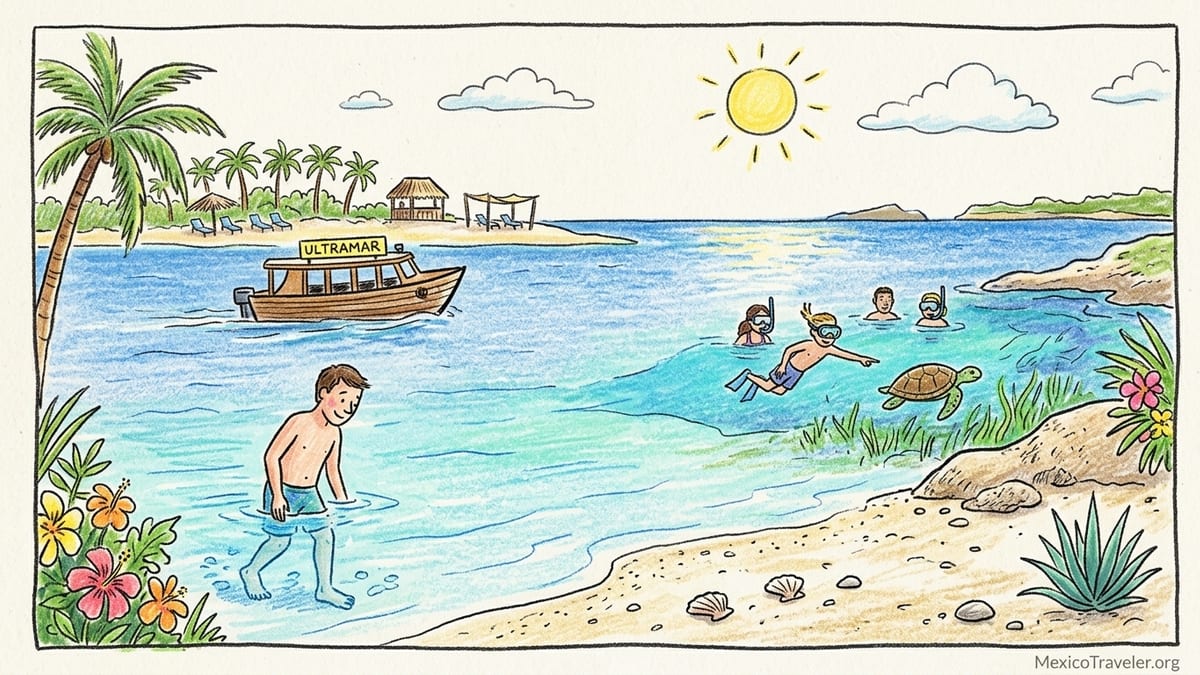
Isla Mujeres is also a practical win for travelers because the ferry system is established and straightforward. Ultramar, one of the primary operators, publishes fares online, which helps you plan instead of guessing at the dock. I liked having that bit of predictability because it’s easy to build a beach day around: arrive, swim, eat something simple, swim again, then head back without turning it into an expedition.
Puerto Morelos And The Riviera Maya: My “Workable, Repeatable” Beach Day
Puerto Morelos felt like a middle ground that actually worked: less frantic than Cancún, less scene-heavy than some of the flashier stretches farther south. The sand here can be slightly more textured, and parts of the shoreline feel more natural, with fewer towering resort walls pressing right up against the beach. The water color is still Caribbean-clear, but it can read a bit more sea-green on certain days, especially when wind and clouds change the light.
Swimming here felt honest. In places where the reef influences the water, you notice how the sea calms in patches and how the bottom changes from pure sand to sand with seagrass and occasional rocky areas. The entry is usually manageable, but it’s not always that endless shallow runway you get in the calmest island coves. What I liked most was that it felt like a place you could return to again and again without needing perfect conditions to enjoy it.
This is also where the sargassum lesson really sank in: different pockets of the Riviera Maya can look totally different on the same day. One beach might have a clean swim lane while another, only a short ride away, collects seaweed in thick lines. I started planning mornings around flexibility: a beach with an easy “Plan B” nearby, rather than committing to a single famous shoreline and hoping the conditions matched the brochure.
Playa Del Carmen: The Beach That Looked Better Than It Swam
Playa del Carmen is a place I enjoy for its energy, but as a pure swim beach it didn’t always win me over. The central beach stretches can be busy, and the shorefront feels active in a way that can interrupt a peaceful swim: constant movement, music from multiple directions, and the feeling that you’re sharing the water with a rotating cast rather than settling in. The sand is pleasant, but the beach day here can be more about the overall scene than the water itself.
When I did swim, I paid attention to how quickly the shallow comfort zone ended. Depending on the exact stretch and the day’s wave pattern, the entry could go from ankle-deep to chest-deep with fewer “rest steps” than I wanted. It’s not that the swimming is bad, it’s that it’s less consistently satisfying than the places where you can wade in slowly and float without thinking about the next wave set or the next crowd surge.
That said, Playa del Carmen is a gateway to some of the best water experiences in the region. If your goal is a swim you’ll remember, I found it worked better as a launching pad: base yourself here for the convenience, then take the ferry over to Cozumel when you want the kind of clarity and reef structure that makes snorkeling feel like entering another layer of the Caribbean.
Akumal And Tulum: The Marine-Life Swim, The Famous Beach That Disappointed Me
Akumal is one of the few places where the swim and the marine life are the headline at the same time. When conditions line up, you can be in calm water with a sandy entry and then, not far out, find yourself sharing the shallows with green sea turtles moving with that calm, prehistoric patience. I also saw schools of smaller reef fish and, in clearer moments, rays gliding low over the bottom. It’s the kind of swim that changes your pace: you stop rushing, because you don’t want to spook anything, and you end up floating more than stroking.
Akumal also taught me to respect the difference between “accessible” and “easy.” The water can be friendly, but the area is popular and rules around turtle encounters and guided access can shape your experience. When I had the best swim, it wasn’t because I got the perfect photo. It was because I gave myself time and space, kept movements slow, and accepted that the turtles set the tempo, not me.
Tulum, on the other hand, is where my most famous-beach expectations crashed into reality. The coastline can be stunning, but the famous stretches were not the swim I would automatically repeat. The combination of crowds, the feeling of managed access in certain areas, and the way conditions can shift made it less relaxing than the images suggest. And in 2026, even getting to the water has been part of the conversation: the federal government published new official tariffs connected to Parque del Jaguar and related access, with changes taking effect on July 20, 2026, while local and visitor experiences on the ground have been widely discussed and sometimes confusing. For a swim-focused traveler, that friction matters.
If I were choosing a deliberate return swim near Tulum, I would pick a quieter, less-hyped stretch where the beach day is simpler, or I’d use Tulum for early-morning water time and then pivot inland or north when the shoreline gets crowded. Tulum is beautiful, but for me it was the famous beach that disappointed as a repeatable swimming experience.
Cozumel And Mahahual: Reef-Edge Water Vs. Laid-Back Far South Calm
Cozumel is where the water turned into glass and then, just a few fin-kicks later, became a window. Even from shore-accessible areas, you can feel the island’s reef personality: the bottom changes quickly from sand to rock and coral structure, and the fish life becomes specific rather than generic. In the clearest swims I had, I saw angelfish and parrotfish among the coral, as well as sergeant majors flashing their bold stripes. The snorkeling here isn’t a vague promise, it’s a real “mask on, face in, wow” moment if you choose a spot with structure.
What you also feel in Cozumel is that reef-edge water can come with movement. Depending on where you enter, you might have a gentle drift that’s pleasant if you’re comfortable, or a current that makes you keep an eye on your starting point. The best Cozumel swims for me were the ones where I treated it like a reef swim, not a pool: I took my time, entered carefully over rocky patches, and stayed aware of where the water wanted to carry me.
Mahahual, far south on the Costa Maya, gave me a different kind of satisfaction: a slower beach day with a more local rhythm. The vibe can be shaped by cruise schedules, but outside peak pulses it felt refreshingly straightforward. The sand and water can still deliver that Caribbean brightness, and I found the swimming experience here to be more about easy floating than chasing dramatic reef drop-offs. If Cozumel is the place I return to for the underwater detail, Mahahual is the place I return to for the exhale.
Sargassum And Water Quality: The Reality Check That Makes Better Beach Days
The most practical thing you can do before a Mexican Caribbean swim day is accept that conditions vary by location and by day, and that sargassum is not a small detail. In 2026, Mexico’s Navy (SEMAR) has continued publishing daily sargassum bulletins for the Mexican Caribbean through its operational oceanography monitoring, and those bulletins are one of the few consistent tools that reflect near-term conditions rather than last year’s travel memories. If you are planning a swim-focused trip, build a habit: check the daily SEMAR bulletin in the morning and be willing to swap beaches, even if it means changing the “perfect” plan.
It also helps to understand why the experience can differ so dramatically. Some shorelines face currents and wind patterns that push sargassum straight in, while others sit in positions that can be temporarily protected. Even within the same destination, one pocket can be clear while another collects seaweed in thick lines that change the smell and the feel of the entry. I’ve had days where I walked a few minutes down the beach and found a cleaner swim lane, and other days where the better solution was simply to go elsewhere rather than trying to “power through” a rough shoreline.
Separately, sargassum is not the same thing as water quality monitoring. Mexico’s federal beach-water monitoring is handled through COFEPRIS in coordination with state health authorities, and it focuses on bacteriological indicators used to determine whether a beach is suitable for recreational contact. For Verano 2026, COFEPRIS publicly reported that the vast majority of monitored beaches were considered suitable, and it also identified specific beaches that were not. If you want a swim that feels good in every sense, it’s worth checking the most recent COFEPRIS monitoring results and, where available, using the Playas Mx tool that Semarnat and COFEPRIS have promoted for consulting results more easily.
In practice, I use a two-check system. First: SEMAR’s daily sargassum bulletin tells me whether today’s shoreline is likely to be clear or messy. Second: COFEPRIS monitoring tells me whether the water meets the bacteriological criteria for recreational use in the latest sampling cycle. When both look favorable, I commit to a longer swim day. When either looks questionable, I treat the beach like a quick look, not a full-day promise.
The Takeaway
If you made me pick the beaches I would swim at again on purpose, not just visit, I’d return to Isla Mujeres for the calm, forgiving entry and the relaxed float feeling that lasts all day. I’d return to Akumal for the rare, humbling experience of sharing warm shallows with sea turtles and rays when conditions allow and rules are respected. I’d return to Cozumel when I want reef clarity and specific fish, and to Mahahual when I want the day to feel slower and less managed.
Cancún is still worth swimming, but I treat it like a beach that requires checking the day’s mood: wind, waves, and crowd level can change the experience fast. Playa del Carmen works better for me as a base than as the swim itself. And Tulum, despite its fame, is the beach I’d stop idealizing. Between access friction and variable conditions, it’s not the repeatable, easy swim I wanted it to be.
The real secret is not picking one “best” beach, but picking a small portfolio: one island-calm option, one reef-and-snorkel option, and one quieter fallback. Then you let the morning’s sargassum bulletin and the latest water-quality monitoring guide your final choice, instead of hoping the Caribbean behaves like a static postcard.
FAQ
Q1. What’s the single best all-around swimming beach near Cancún?
For the most consistently relaxed swim, Isla Mujeres tends to deliver calmer, more forgiving water than the busiest mainland stretches.
Q2. Which beach disappointed you even though it’s famous?
Tulum was the famous beach that disappointed me as a repeatable swimming experience, mainly due to crowding, access friction, and day-to-day variability.
Q3. Where did you have the best chance of seeing sea turtles while swimming?
Akumal is the standout for turtle encounters in shallow water when conditions and access rules align.
Q4. Where would you go for the most impressive snorkeling from shore?
Cozumel is the strongest choice for reef structure, clear water, and seeing specific reef fish like parrotfish and angelfish.
Q5. Which destination felt quieter and worth returning to for a laid-back beach day?
Mahahual felt like a deliberate exhale compared with the busier northern corridor, especially outside peak cruise pulses.
Q6. How do you check sargassum conditions in real time?
SEMAR publishes daily 2026 sargassum bulletins for the Mexican Caribbean; checking the morning bulletin helps you choose the cleanest shoreline that day.
Q7. Is sargassum the same as poor water quality?
No. Sargassum is seaweed that affects the shoreline experience, while federal water-quality monitoring evaluates bacteriological safety for recreational contact.
Q8. Where can travelers check official beach-water monitoring results?
COFEPRIS publishes monitoring results, and Semarnat and COFEPRIS have promoted the Playas Mx tool to consult beach-water quality information more easily.
Q9. If the sea is rough in Cancún, what’s a good Plan B for swimming?
A common Plan B is shifting to Isla Mujeres, where the north-end waters are often calmer, or choosing a more protected pocket along the coast that day.
Q10. What’s the best strategy for a short trip when you want great swims despite changing conditions?
Pick a base with easy mobility, then stay flexible: check the daily sargassum bulletin, confirm water-quality monitoring, and be willing to swap beaches in the morning.