


I went to the Mexican Caribbean thinking I was booking one long ribbon of turquoise beach, with a few postcard stops stitched together by easy shuttles. What I actually found was a chain of very different places that share the same humidity and the same bright Caribbean light, but not the same vibe, not the same logistics, and definitely not the same day-to-day reality. One night felt like a glossy resort bubble; the next felt like a sleepy fishing town with a reef offshore and a single main road. And when sargassum showed up, it didn’t show up evenly. It changed my swim plans by the hour.
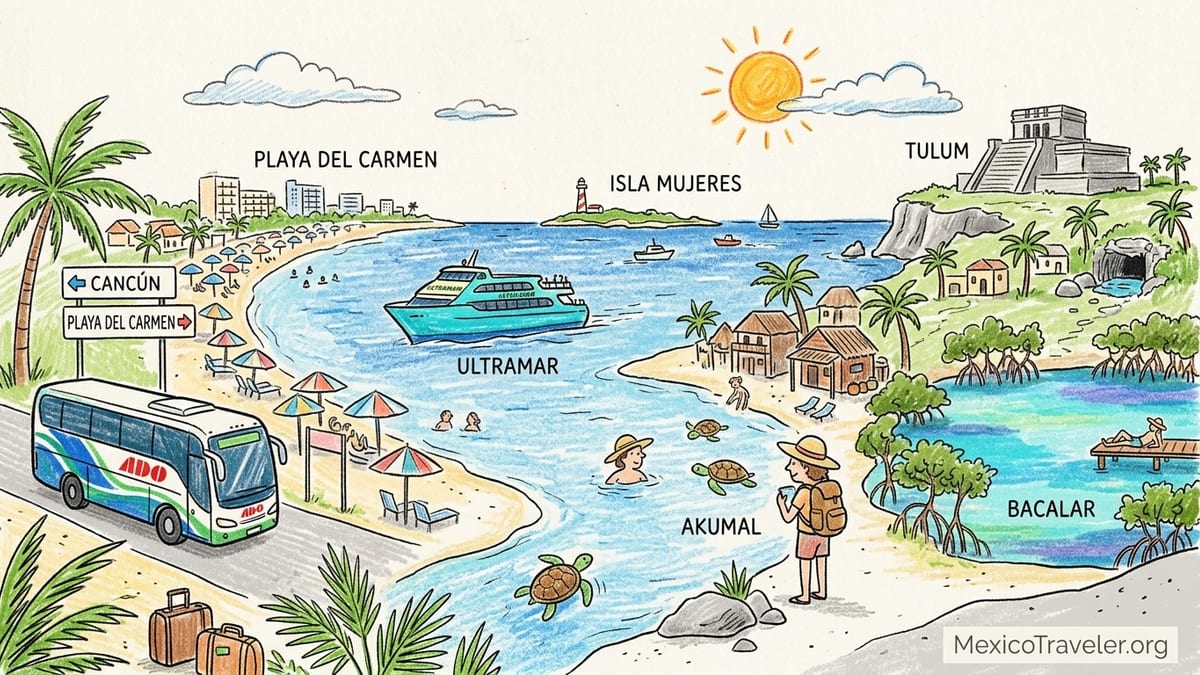
How I Moved Along The Coast (And What I’d Do Differently)
I started in Cancún (CUN), because it is still the easiest entry point if you want to begin on the northern end and work your way down. Landing at Cancún International Airport felt like stepping straight into wet heat; the humidity hit me before I even found my baggage carousel. I used ADO buses for my first big hop, and that decision shaped the entire trip. ADO runs airport buses from Terminals 2, 3, and 4, and the biggest practical detail is this: it is not a hotel drop-off service. It is point-to-point transport to bus terminals, which is perfect if you’re traveling light and can handle a short taxi or local ride at the other end.
My first ADO ticket, Cancún Airport to Playa del Carmen, cost about MXN 270 one-way when I checked and booked it. That fare is worth knowing because it becomes a baseline for planning: it is often cheaper than shared shuttles, and it avoids the negotiating that can make arrival days stressful. I bought the ticket directly through ADO’s ticketing system and then followed the signs at the terminal for the ADO boarding area. The bus was air-conditioned enough that I actually got cold, which was a welcome contrast after the sticky airport curb.
What surprised me most wasn’t the bus itself, it was the time cost of “simple” transfers. Even when the ride time looks short on a map, delays add up: traffic around Cancún, the heavy flow near Playa del Carmen, and the stop-and-go approach into Tulum can eat your afternoon. I learned to treat each transfer day as its own travel activity, not as a throwaway morning. If I were building this route again, I’d cut one base and add nights where I could wake up and swim without packing. In my case, Bacalar deserved more nights, while I felt rushed in Puerto Morelos and Akumal because I tried to squeeze them in between bigger hubs.
Cancún And Costa/Playa Mujeres: Resort Geometry, Big Beaches, Real Crowds
Cancún is two different places: the Hotel Zone that curves like a long comma along the water, and downtown where daily life feels more Mexican and less like a resort brochure. I stayed in the Hotel Zone because I wanted one easy beach day to reset after the flight, but I made a point to get out of the all-inclusive gravity field and see the city beyond the lagoon bridges. The Hotel Zone beach felt expansive and bright, but it also felt managed. You notice it in small ways: the line of beach furniture, the security presence at some entrances, and the way the beach experience is often attached to a property or a beach club rhythm.
Then I spent time up toward Costa Mujeres and Playa Mujeres, and the difference was immediate. The coastline up there felt calmer and more self-contained, with fewer random passersby and a more “planned” resort landscape. The water can look just as Caribbean-blue, but the feeling is not the same as central Cancún. In Cancún, I constantly heard street noise and felt the city’s pulse. In Costa Mujeres, the soundtrack was more wind, more palms, more resort logistics. If you want a true do-nothing beach reset, that quieter north stretch can be more restful than the main Hotel Zone strip.
Crowds are part of the Cancún bargain. I was there in the kind of weather that makes you want to live in the sea, and I still found myself choosing swim times based on when the beach felt breathable. Early mornings were my favorite: softer light, fewer people, and the sense that you had a few hours before the day’s tour buses and beach club energy fully arrived. The practical takeaway is that Cancún is a strong first or last stop for flights, but it is not where I felt the Mexican Caribbean’s personality. For that, I needed to move.
Isla Mujeres: A Ferry Ride From Chaos To Calm (But Only If You Pick Your Corners)
I did Isla Mujeres as a deliberate contrast: one day to trade multilane roads for golf carts and salt air. I took Ultramar out of Puerto Juárez, which is the main and most straightforward ferry point on the Cancún side for Isla Mujeres. Ultramar also runs a service from Playa Tortugas in the Hotel Zone, which is convenient if you are staying on the strip and want to avoid a cross-city taxi. The ride itself was the moment my brain finally unclenched. Ferry crossings on this coast are not just transport, they are a reset button.
Isla Mujeres can feel like two islands, depending on where you spend your time. The north end is compact, walkable, and busy in a way that still feels charming if you accept it as part of the experience. I ate simply there, the kind of meal that tastes better because you’re still damp from swimming and a little sun-drunk. But the island also rewards distance. Once I moved away from the tight downtown area, the roads opened up, the views widened, and the island felt less like a day-trip funnel.
The most important Isla Mujeres lesson I learned is to plan your return ferry with intention. Late afternoon can stack up with other day-trippers, and the dock area turns into a patient shuffle. I built in buffer time and treated the ferry like a real schedule commitment, not an afterthought. If I were doing this again, I would sleep one night on Isla Mujeres instead of trying to compress it into a single day. That one extra morning swim before the day-trippers land would be worth rearranging the whole route.
Puerto Morelos: The Anti-Party Stop With The Reef Right There
Puerto Morelos was the stop that most disrupted my expectations, in a good way. On a map, it looks like it should feel like a smaller Playa del Carmen. In reality, it felt more like a town that still belongs to its locals, with tourism flowing through but not fully controlling the rhythm. The beach scene was lower-key, the streets were less polished, and I felt less pressure to “do” something every hour. It was the first place on this route where I could sit with a coffee and hear regular life around me.
Snorkeling here is one of the most appealing, practical activities because the reef is the main draw. Puerto Morelos sits next to the Arrecife de Puerto Morelos National Park, and the reef trips are the kind of half-day excursions that actually make sense even if you’re trying to keep your itinerary light. I booked a small-boat snorkel that focused on time in the water rather than a big-party catamaran vibe. The water visibility and reef life can vary by conditions, but the reason this stop works is its simplicity: you do not have to travel far to feel like you are in the real Caribbean.
I did not give Puerto Morelos enough time. I treated it like a transit stop, and I regretted that immediately because it is exactly the kind of place that makes a long trip feel balanced. If Cancún felt like a polished starting line and Playa del Carmen felt like a hub, Puerto Morelos felt like a breath. On a second trip, I would make this a two-night stop specifically to slow down and snorkel once without squeezing it between transfer windows.
Playa Del Carmen, Cozumel, And Akumal: Convenience, Crowds, And The Best Swim Days
Playa del Carmen is the transportation hinge of this region. It is where the coast starts to feel intensely connected to day trips: ferries to Cozumel, vans and taxis in every direction, and a constant flow of people moving between hotels, beach clubs, and tours. Quinta Avenida can be entertaining in small doses, but it also quickly felt like sensory overload for me. When I needed the beach, I found that timing mattered. Midday heat plus crowds plus music can make it feel like the city is doing the beach for you rather than you choosing it.
From Playa del Carmen, I took the ferry to Cozumel, and that crossing changed my whole relationship to the trip. Cozumel felt like the place where the Mexican Caribbean finally pivoted from beach tourism to marine life. The ferry route is well-served by Ultramar and Winjet, and fares can differ depending on direction and fees. I watched the ticket windows carefully, bought in pesos, and kept my plan simple: one or two big snorkel or swim blocks, then a late ferry back. On Cozumel, even a short day can feel full because the water activities are the main course, not an optional side.
Akumal, further south along the Riviera Maya, felt like a calmer version of what people hope the whole coast will be. The water was inviting, and the area’s reputation for snorkeling draws a steady stream of visitors. I planned it as a swim-focused stop, and that was the right call. The key is to arrive early, before the beach becomes a staging area for multiple tours. My best hours were the ones that felt quiet enough to hear my own breathing through my snorkel, when the sea surface was glassier and the shoreline was not packed with people adjusting fins.
This stretch also taught me a hard truth: sargassum does not respect your itinerary. I checked live conditions before committing to a beach afternoon, and I still got surprised. On September 20, 2026, monitoring based on satellite imagery showed minimal sargassum off some Cancún beaches while Playa del Carmen was flagged as heavy that same day, which matches what travelers often experience on the ground: big differences over short distances. I built flexibility into my day, and when the beach wasn’t appealing, I shifted inland for cenotes or food rather than forcing a swim in unpleasant conditions.
Tulum: The Place That Looks Like A Dream Until You Meet The Rules, The Traffic, And The Fees
Tulum was the most complicated stop on my route, and also the one I had romanticized the most. It is still beautiful, but it is not simple. The first reality check was traffic: the main road and the beach road can feel like a slow-moving procession, especially at peak times. The second reality check was the way access works now, especially around the archaeological zone and beach areas tied into protected zones. It is no longer the kind of place where you casually drive up, park easily, and wander in without thinking about entry systems.
I visited the Tulum archaeological zone, and I did it early because the heat and crowds build fast. Official site information is published by INAH, and while the ruins themselves are iconic, the broader visitor experience now includes overlapping access structures connected to protected areas. In mid-2026, Mexico’s federal government publicly announced new measures under a “Plan Tulum Renace” approach, including changes around the Parque del Jaguar and access, so I went in expecting the on-the-ground setup to be evolving. That expectation helped. I kept cash in pesos, arrived early, and accepted that signage and procedures can feel confusing until you are standing in the flow of people.
The unexpected highlight of Tulum for me wasn’t the beach clubs or the nightlife. It was the inland water. When sargassum makes the shoreline less appealing, the region’s cenotes become the reliable alternative, but they come with strict etiquette. Many cenotes require a shower before entering, and sunscreen and insect repellent are treated as serious issues because you are swimming in an aquifer. I carried a long-sleeve rash guard and treated “no chemicals” as the default, not as a suggestion. That choice made my cenote days easy because I wasn’t negotiating with myself at the entrance gate.
If I were planning my route again, I would either give Tulum more time to handle the logistics calmly, or I would base outside the busiest part and day-trip in. I felt rushed because I tried to do ruins, beach, and a cenote day while also dealing with transfers. Tulum is not a quick stop anymore. It is a destination with its own learning curve, and you enjoy it more when you stop fighting it.
Bacalar (And How The Caribbean Turns Into A Lagoon Story)
By the time I reached Bacalar, I was ready for the coast to change, and it did. Bacalar is not the Caribbean Sea, and that is exactly why it felt like relief. The color still exists, but it is a lagoon palette rather than an open-ocean horizon. The air felt slightly calmer at night, and the town rhythm was slower. Instead of planning my day around beach clubs, I planned it around water access points, sunrise light, and the simple pleasure of getting in the lagoon and floating.
Bacalar also comes with rules that I think every traveler should treat as non-negotiable. The lagoon’s ecology is fragile, and local guidance emphasizes protecting stromatolites, respecting buoyed-off zones, and avoiding sunscreen in the water even if it is marketed as biodegradable. I saw signage and heard the same message repeated in different ways: the lagoon’s health depends on visitors not treating it like a pool. The most useful thing I did was build my Bacalar days around low-impact swims and guided activities that clearly respected protected areas.
This was the place that deserved more nights. I arrived after a fast-paced stretch of coastal hubs, and Bacalar instantly made me want to stop moving. If I could rework my itinerary, I would shorten my time in Cancún and Playa del Carmen by a night each and give those nights to Bacalar. I would also consider flying out of a different airport if that made the return less exhausting, because Bacalar feels far from the northern tourist spine, and that distance is part of its magic.
Mahahual Or The Costa Maya Detour: When I Wanted The Sea Again, But Not The Same Scene
Mahahual is the detour I recommend when you want to feel the sea again after Bacalar, but you do not want to return to the intensity of Playa del Carmen or Tulum. It is a small coastal town in the Costa Maya region that can feel peaceful on non-cruise days and suddenly crowded when a ship is in port. That contrast is the whole planning trick: Mahahual can be wonderfully simple, but you have to pay attention to the calendar rhythm of cruise calls if you want the calm version.
What I liked about Mahahual was the way it reset my expectations again. The coast here felt less about curated experiences and more about a handful of beach-facing spots where you can eat, swim, and watch the day. I treated it as a beach-and-meal stop rather than a checklist destination. The water conditions, including sargassum, still matter here, but the town’s scale makes it easier to pivot. If the shoreline looks messy, you do not feel trapped in a massive resort machine. You just adjust your plan and move on.
If I were mapping this entire region for a reader who wants variety, I would describe Mahahual as the “optional south-coast exhale.” It is not mandatory the way Isla Mujeres or Tulum might feel for first-timers, but it is a meaningful contrast. It reminded me that the Mexican Caribbean is not one experience. It is a string of micro-worlds, and the best trips are the ones that let those differences be the point.
The Takeaway
The Mexican Caribbean rewarded me most when I stopped trying to experience it as one continuous beach and started treating it like a series of distinct destinations with different logistics, different crowd patterns, and different best-use cases. Cancún was my easiest flight anchor, but not my most memorable stop. Isla Mujeres was my quickest emotional reset. Puerto Morelos was my “why didn’t I stay longer” town. Playa del Carmen was my practical hub, not my dream base. Cozumel was where the water finally felt like the main attraction rather than the background. Tulum was gorgeous but demanding, and Bacalar was the place that turned the whole trip into something calmer and more lasting.
If you take only one planning lesson from my route, make it this: build flexibility into your swim days. Sargassum and weather do not care about your hotel bookings. Check conditions, keep a cenote day in your pocket, and do not be afraid to leave a beach early if it is not delivering. The best moments I had were not the ones I forced. They were the ones I made room for, usually early in the morning, with salt still drying on my skin and no pressure to be anywhere else.
And if you are deciding where to add nights, add them where the pace naturally slows. For me, that was Bacalar and Isla Mujeres. The Mexican Caribbean can be fast and loud if you let it. It can also be quiet, restorative, and deeply beautiful if you plan for the places where the region stops performing and starts feeling real.
FAQ
Q1. What airport should I use for a Cancún to Bacalar route?
Most travelers start at Cancún International Airport (CUN) for flight options, then move south by bus, car, or rail where available.
Q2. Is ADO a good option from Cancún Airport to Playa del Carmen?
Yes. ADO runs airport-to-terminal service (not hotel drop-offs). I paid about MXN 270 one-way when I checked and booked.
Q3. Which ferry did you use for Isla Mujeres?
I used Ultramar, departing from Puerto Juárez on the Cancún side, because it is straightforward and frequent.
Q4. How did you decide between staying on Isla Mujeres or day-tripping?
After doing it as a day trip, I wished I had stayed one night to enjoy a quiet morning before the day-trip crowds arrive.
Q5. Is Puerto Morelos worth adding even if I’m short on time?
Yes, especially if you want a calmer town feel and a reef-focused half-day. I regretted not giving it two nights.
Q6. How much is the ferry between Playa del Carmen and Cozumel?
It changes by operator and direction, but in mid-2026 published fares commonly showed roughly the low-to-mid MXN 300s one-way for adults, plus applicable port-related fees depending on the point of departure.
Q7. What’s the smartest way to deal with sargassum?
I checked live conditions before committing to a beach day, then kept a cenote plan as my backup. Conditions can differ sharply even between nearby towns.
Q8. Are there special rules for cenotes?
Many cenotes require a shower first and strongly discourage sunscreen and insect repellent because the water is part of the local aquifer.
Q9. Has Tulum’s access and fee system changed recently?
Yes. Federal announcements in 2026 signaled changes around Parque del Jaguar and related access. On the ground, procedures can evolve, so arrive early and expect multiple checkpoints or fees.
Q10. What are Bacalar’s most important lagoon rules?
Respect protected zones and stromatolites, follow buoy markers, and avoid sunscreen in the lagoon. The area’s guidance emphasizes low-impact use to protect water quality.