


I’ve booked Mexico the slow, DIY way and the easy, bundled way, sometimes on the exact same route in different years. What surprised me most wasn’t that packages are always cheaper, because they are not. It was how often bundling fixed the most annoying parts of Mexico logistics: airport transfers, check-in timing, and the domino effect of one delay wrecking three separate reservations. At the same time, the more “Mexico” I wanted (small cities, short hops, local hotels, different neighborhoods), the more a package felt like a box I had to live inside. Here’s how I’d book my next Mexico trip now, using what I paid on real trips, what took the most work, and what I’d happily outsource to a good package.
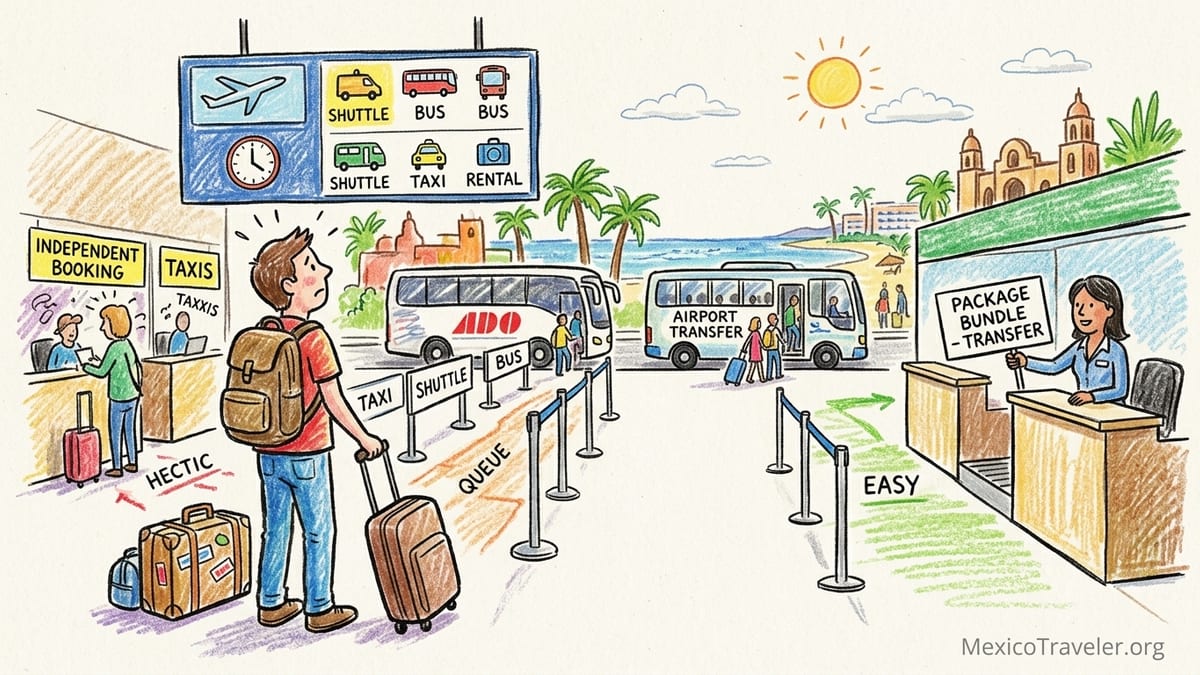
What I Actually Paid Booking Mexico Independently (And What Took the Most Work)
My first independent Mexico trip that felt like a true “I built this from scratch” itinerary was a Cancún to Playa del Carmen base, with day trips out to ruins and cenotes. I booked the flight first, then the hotel, then figured out transfers. The flight was straightforward, but everything after landing took the mental energy. The big surprise was how many decisions you have to make fast in the airport: do you take a prebooked shuttle, a bus, or a taxi, and how do you find the right counter while people are actively trying to steer you elsewhere?
On that trip I paid for flights separately, then booked a mid-range hotel in Playa del Carmen on its own reservation, then paid for transfers as their own transaction. The most work was not comparing hotel prices. The most work was stitching together arrival timing, late check-in, and transportation with enough buffer that if the flight landed late, I would not be stranded with a “driver waited 60 minutes and left” situation. That is the kind of fine print you only read when you are tired and standing under fluorescent lights.
The other big “work” item for independent Mexico is understanding what’s actually included on each component. A flight that looks like a deal can become less of a deal once you pay for baggage, seat selection, or a carry-on. Basic economy baggage rules are one of those hidden stressors if you are traveling with beach gear or staying more than a long weekend. Even when the base fare is low, the total price can creep up fast if your ticket only includes a personal item.
Independently booking also puts you in charge of category translation. “Garden view” can mean a palm-lined path, or it can mean the back of the loading area behind the kitchen. “Two double beds” might be “one double and one sofa.” When everything is booked separately, fixing a mismatch can feel like negotiating with three different companies at once, because you are.
My Package Booking Reality Check: Where Bundling Made Life Easier (Not Magically Cheaper)
The best thing a package did for me was reduce the number of moving pieces I could break. Bundling flight and hotel meant I could see one total cost, one itinerary page, and one confirmation that looked like a single trip instead of a spreadsheet. The second-best thing was that it made me more decisive. When I’m booking independently, I can spend days optimizing, which sounds responsible until you realize you are basically doing unpaid travel-agent labor.
But I do not pretend package savings are universal. Sometimes the package total is cheaper. Sometimes it’s roughly equal. Sometimes it is more expensive but still worth it because it removes the “airport puzzle” and the risk that a late flight turns into a missed check-in and a transfer no-show. I’ve also seen packages that look discounted until you compare them to a fully refundable hotel booked independently plus a flight you can cancel for credit. The value is often in convenience and coordination, not in an automatic bargain.
One place bundling consistently helped was timing. If I’m landing in the evening, I’m happy to pay slightly more to know that the hotel is confirmed in the same booking flow as the flight and that I’m not juggling separate customer service lines if anything shifts. The stress savings are real, even when the dollar savings are not.
The trade-off is flexibility. Packages make it easier to commit, and harder to tinker. If you are the kind of traveler who changes hotels mid-trip because you found a neighborhood you like more, independent booking wins. If you want “arrive, beach, repeat,” bundling can be a relief.
The Trips That Are Naturally Package-Friendly: Cancún and Riviera Maya
Cancún and the Riviera Maya are the most package-friendly parts of Mexico I’ve traveled, because the whole region is built around a predictable flow: airport arrival, transfer corridor, resort or hotel zone, and day trips. If you’re staying in the Hotel Zone, Playa del Carmen, or a large resort area, a flight-plus-hotel bundle can cut down the most annoying part of the trip: getting from the airport to the right place without getting upsold or misdirected.
On my DIY trip, I learned the “simple” option can be the bus. ADO sells airport-to-destination tickets and operates from terminals at Cancún International Airport, specifically from Terminals 2, 3, and 4. That matters in real life because if you land and your terminal does not have the service you expected, you need a backup plan fast. Having a bus alternative also changes how I think about packages: if I can do airport to city cheaply and clearly on my own, I’m less likely to pay extra for a bundled transfer.
Where I think packages shine in this region is when you choose a resort or higher-end hotel where transfers, check-in, and on-property logistics matter. Many travelers want to land and be done. If you are with kids, older relatives, or you simply do not want to do the airport dance after a long travel day, bundling can be worth it even if it costs more.
The downside I’ve personally encountered in the Riviera Maya style of trip is hotel-category surprise. In a bundle, you can end up with fewer chances to customize the room class, building, or bedding. If you care about “oceanfront” versus “partial view,” or you need guaranteed bed types, I would verify the exact room category before committing, and I would not assume a package defaults to a better room.
Los Cabos: Where Transfers And Ground Rules Change the Math
Los Cabos is where I feel the package argument gets stronger, because arrival logistics can be less forgiving. At Los Cabos International Airport, rideshare rules are stricter than many travelers expect. Uber and DiDi are not permitted to pick up at the airport, and the practical options are authorized taxis, pre-booked transfers, shuttles, buses, or a rental car. That single detail changes the stress level of arrival, and it changes the value of a bundle that includes transfers or at least makes transport decisions clearer upfront.
When I booked Los Cabos independently, I had to solve two problems: transportation and expectations. Transportation meant deciding between a shuttle, a private transfer, or a rental car. Expectations meant reminding myself that “quick and cheap” is not the default at every Mexican airport, and that local rules can make your preferred app-based option unavailable at the curb. That’s the kind of detail that doesn’t show up in a glamorous beach photo but can define the first hour of your vacation.
This is also where flight-plus-hotel-plus-car bundles can look tempting, but I would be careful with the car part of the bundle. In Mexico, rental car pricing can be confusing if you arrive expecting the online total to be the final total. Insurance and liability coverage rules are not always what U.S. travelers assume. Hertz, for example, outlines Mexico-specific insurance and liability coverage details in its Mexico insurance information. The key point for travelers is not the brand, it’s the reality: the counter conversation about coverage is part of the experience, and it can change your final bill.
If you are staying in Cabo San Lucas or the resort corridor and you are not planning major day trips, I often prefer a package that includes hotel and flight, plus a transfer, and skip the rental car. If you are going to explore, rent a car, but go in with clear expectations about what coverage you will actually need and what is already included.
Puerto Vallarta: Great For DIY, With One Big Airport Transfer Gotcha
Puerto Vallarta is one of my favorite places to book independently because it’s a city and a beach destination at the same time. You can stay in the Romantic Zone, Centro, Marina Vallarta, or farther north in Nuevo Vallarta, and the vibe changes meaningfully by neighborhood. That kind of neighborhood shopping is where independent booking feels like a superpower.
The big gotcha is the airport pickup experience. In Puerto Vallarta, it is common for travelers to use rideshare, but pickup rules can be different at the airport itself than they are elsewhere in the city. Uber’s own airport guidance for Puerto Vallarta exists, but the practical reality on the ground often involves walking to an authorized pickup point. If you’re arriving sweaty, carrying bags, and you just want to get to your hotel, this is exactly where a bundled transfer can feel like the best money you spent all week.
I’ve done it both ways: a prebooked transfer that met me with a sign, and the DIY method that worked but required more effort and patience. The moment you are traveling as a group, or you have bulky luggage, or you land late, convenience becomes a real value, not a luxury.
Where Puerto Vallarta is less package-friendly is when you want to move around: two nights in town, then a small boutique stay, then a quieter beach area. The more you hop, the more you benefit from booking independently.
Cancellations, Refunds, And The Fine Print I Now Read First
I used to assume cancellation was mostly about the hotel. Now I treat it as a three-part puzzle: flight rules, hotel rules, and how the platform treats a “package” when you try to unwind it. Expedia’s own Terms of Service describe a package as separate travel services booked together, with each component still subject to its own rules and restrictions. In practice, that means you might cancel one itinerary and receive different outcomes: a hotel refund if you booked a refundable rate, and a flight credit depending on the airline ticket rules.
If you want extra flexibility on a package, some platforms sell add-ons designed for cancellation or changes. Expedia’s Vacation Waiver terms spell out how a waiver can apply to a trip that includes multiple products in the same itinerary, and how travel credits and airline rules may still be involved. The takeaway is not “always buy the waiver.” The takeaway is “know exactly what problem you’re trying to solve.” If you’re worried about hotel flexibility, choose a refundable hotel rate first. If you’re worried about flights, choose an airfare that you can change or cancel under terms you can live with.
I’ve had one cancellation where independent booking saved me. The flight changed, which triggered a chain reaction, but because I had booked the hotel on a fully refundable rate and the transfer separately, I could cancel or adjust each part without asking permission from a bundled itinerary. That was the upside of separate components: I could move pieces around without breaking everything.
I’ve also had the opposite experience, where a package simplified the process because I could manage changes from one itinerary page rather than digging through emails from three providers. Costco Travel, for example, states it does not charge additional cancellation fees, and it provides a cancellation timeline for refund details on the booking. That doesn’t mean everything is refundable. It means the process is clearer and often less punitive than you might expect, depending on the supplier terms attached to your specific trip.
What Packages Look Like Right Now (And How I’d Use Them In 2026)
Vacation packages in 2026 are not just resort-only bundles anymore. Major platforms let Mexico travelers combine flight and hotel, and often add a car. Expedia’s package page explicitly promotes options like flight plus hotel, and the ability to add a car, while also pushing member pricing, “book now pay later” options, and fully refundable rates on many hotels. Booking.com also markets flight-and-hotel packages, including all-inclusive resort options, with Mexico destinations clearly represented in its package flow. Priceline similarly positions packages as a way to combine hotel, flight, and car in one checkout.
That structure matters because it changes how I recommend using packages. If you can bundle hotel and flight, then still book your airport transfer separately with a provider you trust, you can get some of the convenience benefits without giving up control of every detail. Or you can do the opposite: bundle flight and hotel, then add a car only if you truly need it, rather than defaulting to a car because the bundle makes it look cheap.
In 2026, the most practical way I see travelers using bundles is as a framework, not a cage. Pick a package for a beach hub where you want simplicity: Cancún, Riviera Maya, Los Cabos, Puerto Vallarta. Then customize around it with experiences, dining, and day trips. If you’re doing a multi-city cultural itinerary, use independent booking so your trip can breathe.
If you want flexibility, I’d prioritize refundable hotel rates, clear cancellation windows, and a flight fare class you understand. If you want simplicity, I’d prioritize a clean arrival: confirmed hotel, confirmed transport plan, and no surprises about baggage fees, room category, or car insurance at the counter.
The Takeaway
If I were booking Mexico again tomorrow, I would not ask, “Should I book a package or not?” I’d ask, “What part of Mexico is this trip, and how many moving pieces am I willing to manage?” For a beach hub with predictable logistics, bundling flight and hotel can simplify the trip, and adding a transfer can remove the most stressful hour of the vacation. For a cultural, multi-city itinerary, independent booking usually wins because flexibility is the whole point.
Packages are best when they reduce friction you can’t easily solve on your own: arrival rules that make rideshare complicated, late-night landings, family travel, or trips where you want one itinerary to manage. Independent booking is best when you care about neighborhoods, boutique hotels, changing plans mid-trip, or you want to hand-pick every component, including transportation and room category.
My personal rule now is simple: bundle for convenience, not because I assume it’s cheaper. Then do a quick reality check by pricing the same flights and a comparable hotel separately, including baggage, transfers, and the cancellation terms I can actually live with.
FAQ
Q1. Are Mexico vacation packages always cheaper than booking separately?
Not always. Sometimes the bundle price is lower, sometimes it’s similar, and sometimes it costs more but saves you time and reduces logistics stress.
Q2. Which Mexico destinations are the most package-friendly?
Cancún and the Riviera Maya, Los Cabos, and Puerto Vallarta tend to be package-friendly because they have established resort zones and common transfer routes.
Q3. When does independent booking usually work better in Mexico?
It often works better for multi-city cultural trips where you want flexible hotel choices, short stays, and the ability to change plans without affecting bundled components.
Q4. If I book a package, can I still choose a refundable hotel?
Often yes. Many platforms show refundable hotel rate options inside package results, but you must open the rate details and confirm the cancellation window for that specific booking.
Q5. If I cancel a package, do I get one refund or separate refunds?
It is commonly handled by component. Flights, hotels, and cars can each have different cancellation rules even when purchased together in one itinerary.
Q6. Do packages include airport transfers by default?
Not always. Some resort packages include transfers, but many flight-plus-hotel packages do not. You may need to add a transfer or book it separately.
Q7. What’s the biggest “surprise” cost when renting a car in Mexico?
Insurance and liability coverage requirements can change the total at the counter. Travelers should confirm what coverage is included and what is required locally before arriving.
Q8. What’s a good low-effort transfer option in Cancún if I’m not using a package transfer?
ADO buses operate from Cancún Airport terminals 2, 3, and 4, and can be a straightforward alternative for certain routes depending on where you are staying.
Q9. How do baggage rules affect the package vs DIY decision?
A low flight price can grow once you add carry-on or checked bag fees. Always compare total trip cost including baggage when checking package savings.
Q10. What’s your simplest rule for deciding whether to bundle?
Bundle when you want a smooth arrival and fewer moving parts. Book independently when your itinerary is complex and flexibility matters more than convenience.